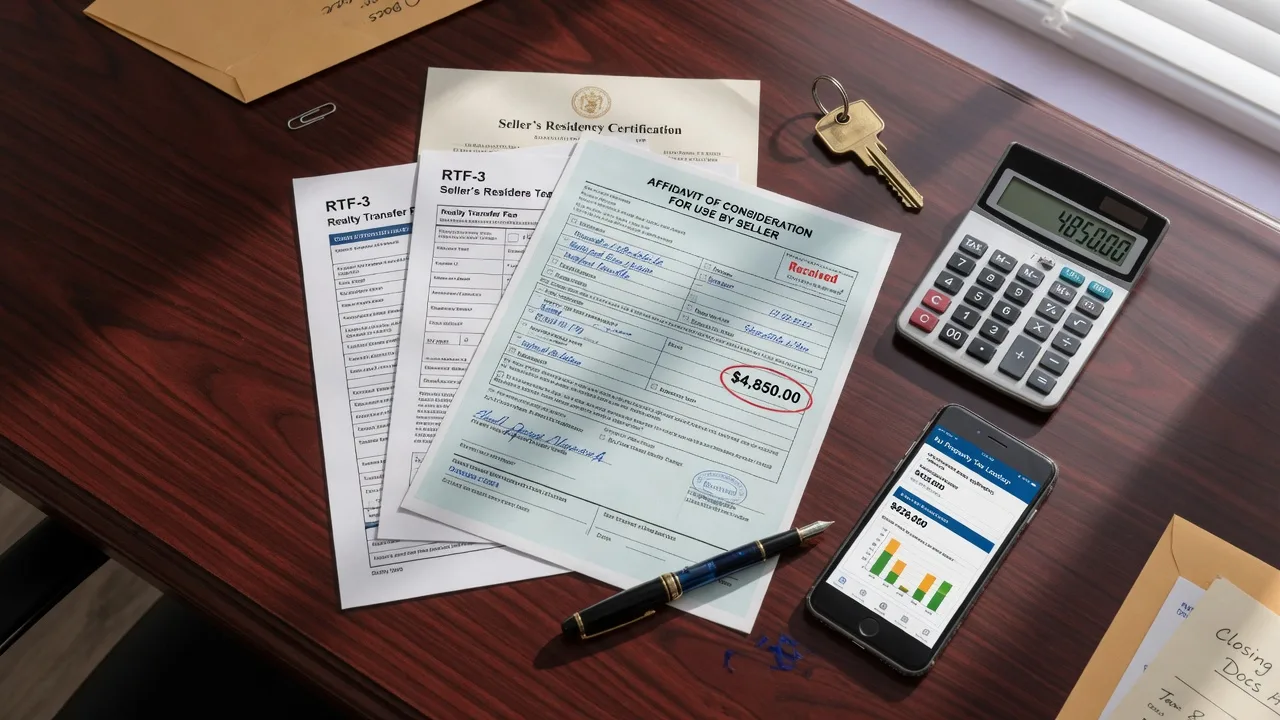
The New Jersey Realty Transfer Fee is one of the largest closing costs a seller faces when selling a home in our state. Understanding how it is calculated, who pays it, and whether any exemptions apply can save you thousands of dollars and prevent surprises at the closing table.
After helping over 728 families sell their homes across Burlington County and South Jersey, I have seen sellers lose sleep over closing costs they did not anticipate. The Realty Transfer Fee is often the single biggest line item on a seller's closing statement after the mortgage payoff and real estate commission. This guide explains everything you need to know about New Jersey's transfer tax, with clear examples you can apply to your own situation.
What Is the New Jersey Realty Transfer Fee?
The New Jersey Realty Transfer Fee (often called the transfer tax) is a tax imposed by the state on the transfer of real property. It is collected at closing and paid to the state when the deed is recorded. Despite the name suggesting a flat "fee," it is actually a graduated tax that increases with the sale price of the property.
The fee applies to most residential real estate transactions in New Jersey, with a few important exemptions that we will cover later. The revenue generated by the transfer fee goes to the state's general fund and various housing programs.
Who Pays the Transfer Tax in New Jersey?
In New Jersey, the seller is responsible for paying the Realty Transfer Fee. This is standard practice and is written into most purchase contracts. However, as with many things in real estate, the allocation of costs is negotiable. In a buyer's market, a seller may agree to absorb the full fee. In a seller's market, a buyer might offer to pay a portion of it to make their offer more attractive.
The fee is calculated based on the total consideration for the property, which is typically the sale price. It is due at closing and is collected by the county clerk's office or the closing attorney, who then remits it to the state.
How Is the Transfer Tax Calculated?
The New Jersey Realty Transfer Fee uses a tiered rate structure. The rate you pay depends on the sale price of the property and whether the buyer will occupy the property as their primary residence. Here are the current rate tiers:
| Sale Price Range | Rate |
|---|---|
| Up to $150,000 | $1.95 per $500 (0.39%) |
| $150,001 to $200,000 | $3.20 per $500 (0.64%) |
| $200,001 to $550,000 | $3.40 per $500 (0.68%) |
| $550,001 to $850,000 | $4.45 per $500 (0.89%) |
| $850,001 to $1,000,000 | $4.90 per $500 (0.98%) |
| Over $1,000,000 | $5.55 per $500 (1.11%) |
Note: Rates apply to the entire sale price, not just each tier. For example, if your home sells for $400,000, the rate is $3.40 per $500 for the full amount.
Transfer Tax Calculation Example
Let us walk through a real example. Say you are selling your home in Moorestown for $450,000. Here is how the transfer fee is calculated:
If the buyer is a first-time home buyer and will occupy the property as their primary residence, the rate may be reduced, which we will cover next.
Are There Any Exemptions or Reduced Rates?
Yes, New Jersey offers several important exemptions and reduced rates that can significantly lower your transfer tax bill:
First-Time Home Buyer Exemption
If the buyer is a first-time home buyer and will occupy the property as their primary residence, the transfer fee rate is reduced. Instead of the standard rates above, the fee is calculated at $1.95 per $500 for the first $150,000 and $3.40 per $500 for the amount over $150,000. This can save thousands of dollars on a typical home purchase.
To qualify, the buyer must not have owned a home in the previous three years and must sign an affidavit at closing confirming their first-time buyer status. This exemption applies to the entire transaction, so the seller benefits from the lower rate as well.
Senior Citizen and Disabled Person Exemption
Senior citizens (age 62 and older) and disabled persons may qualify for a full exemption from the Realty Transfer Fee when selling their primary residence. To qualify, the seller must have lived in the home for at least 12 consecutive months before the sale. The exemption applies to the first $250,000 of the sale price, and reduced rates apply to amounts above that threshold.
This exemption can save Burlington County seniors thousands of dollars when downsizing. I have helped many families in communities like Moorestown, Medford, and Mount Laurel take advantage of this exemption when transitioning to a smaller home or retirement community.
Low- and Moderate-Income Housing Exemption
Properties sold to low- and moderate-income households through affordable housing programs may qualify for reduced rates or full exemptions. This typically applies to properties sold through municipal affordable housing programs or community development initiatives.
Transfer Between Spouses or Family Members
Transfers between spouses (including divorce settlements), between former spouses under a divorce decree, or between certain close family members may be exempt from the transfer fee. This also applies to transfers to a trust where the grantor retains a life estate.
How Does the Transfer Tax Affect Your Bottom Line?
For sellers, the Realty Transfer Fee is a real cost that directly reduces your net proceeds from the sale. On a typical $400,000 home sale, the fee is approximately $2,720 at the standard rate. On a $600,000 home, the fee jumps to roughly $4,740. On a $1,000,000 home, it reaches about $9,800.
This is why it is critical to include the transfer fee in your net proceeds estimate when deciding on a listing price or evaluating an offer. I always help my seller clients estimate their net proceeds early in the process so there are no surprises when the closing statement arrives.
Estimated Transfer Fees at Different Price Points
Is the Transfer Tax Deductible?
For federal income tax purposes, the New Jersey Realty Transfer Fee is generally considered a selling expense and can be used to reduce your capital gains on the sale of your home. If your home sale exceeds the capital gains exclusion limits ($250,000 for single filers, $500,000 for married filing jointly), the transfer fee can reduce your taxable gain. For most homeowners, the sale of a primary residence falls below the exclusion limits, so the deduction may not apply directly. Always consult your tax advisor for guidance specific to your situation.
Do Buyers Pay Any Transfer Taxes in New Jersey?
Buyers in New Jersey do not pay the Realty Transfer Fee, but they may pay a mortgage recording tax. This tax is based on the amount of the mortgage and is typically $0.50 to $1.50 per $100 of the loan amount, depending on the county. On a $320,000 mortgage, the recording tax could be $1,600 to $4,800. This cost is included in the buyer's closing costs and appears on the Closing Disclosure.
For a complete picture of all buyer closing costs, see our Closing Costs in New Jersey guide.
How the Transfer Tax Varies by County
While the New Jersey Realty Transfer Fee is a state-level tax, some counties also impose additional recording fees or county-level transfer taxes. In Burlington County, the standard state fee applies without any additional county transfer tax. However, if you are selling property in other parts of the state, check with your attorney about any local fees that may apply.
Frequently Asked Questions About the NJ Transfer Tax
Do I pay transfer tax when I buy a home in New Jersey?
No. The New Jersey Realty Transfer Fee is paid by the seller, not the buyer. Buyers may pay a mortgage recording tax and other closing costs, but the transfer fee itself is the seller's responsibility. See our closing costs guide for what buyers pay.
Can the buyer pay the transfer tax?
The seller is responsible by law, but as with many costs in a real estate transaction, the allocation is negotiable. A buyer could offer to pay the transfer fee as a concession, though this is uncommon. Any such arrangement should be clearly documented in the purchase contract.
What is the transfer tax on a $500,000 home in NJ?
At the standard rate of $3.40 per $500, the Realty Transfer Fee on a $500,000 home is approximately $3,400. If the buyer is a first-time home buyer, the rate may be reduced, lowering the fee.
How can I avoid paying the NJ transfer tax?
You may qualify for an exemption if you are a senior citizen (age 62+) selling your primary residence, or if you are disabled. Transfers between spouses or family members may also be exempt. For most standard home sales, however, the fee applies.
When is the transfer tax paid?
The transfer tax is paid at closing and is included in the seller's closing costs. It is collected by the closing attorney or county clerk and remitted to the state when the deed is recorded.
Know Your Costs Before You Sell
The New Jersey Realty Transfer Fee is a significant cost of selling a home, but it should not be a surprise. With the right preparation and a clear understanding of how it is calculated, you can budget accurately and plan your move with confidence.
As your Epique Realty Agent, I will provide you with a detailed net proceeds estimate before you list your home, including the Realty Transfer Fee and all other closing costs. I will also identify any exemptions you may qualify for to help you keep more of your home's value.
My goal is to make sure the only surprise on closing day is how much money you saved.

Bob Millaway
Epique Realty Agent · AI Certified Agent · 728+ homes sold across Burlington County and South Jersey. Licensed NJ Salesperson #791082.