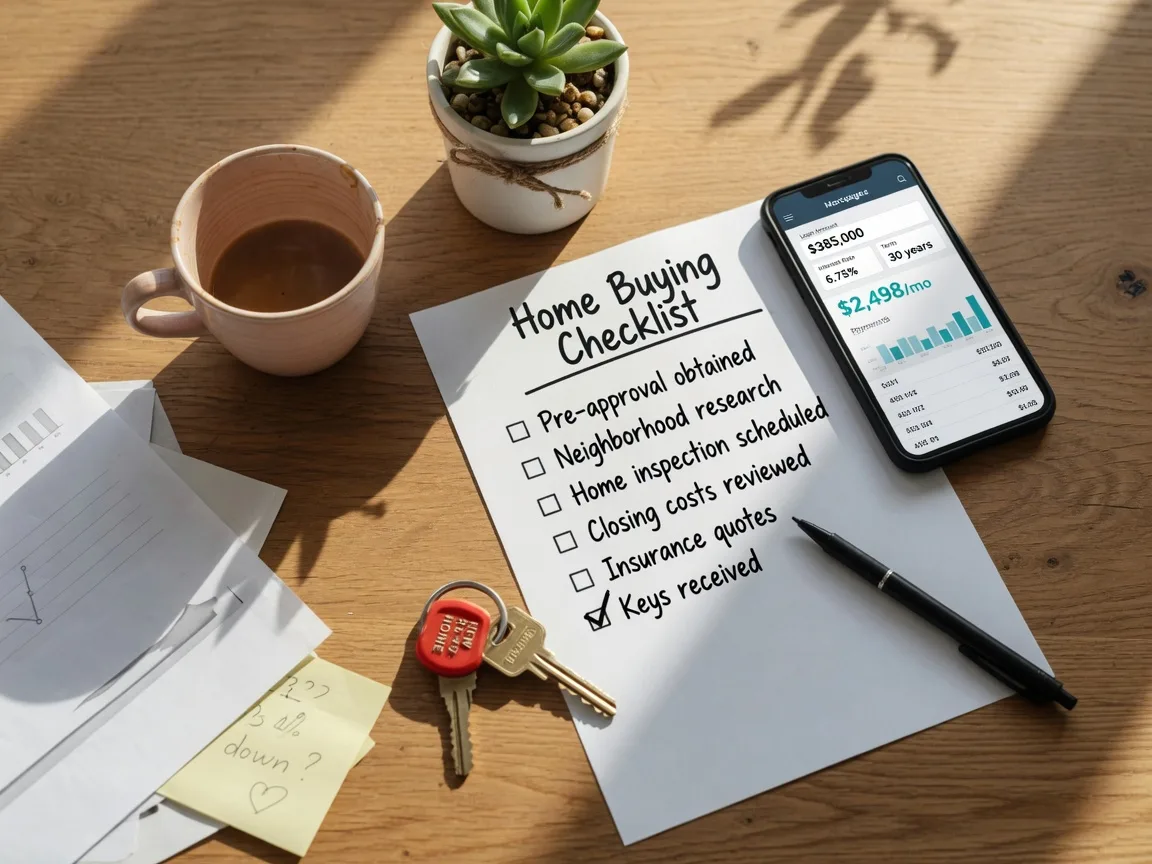
Buying your first home in South Jersey is an exciting milestone, but it can also feel like a long list of unknowns. This checklist breaks the entire process into clear, manageable steps from the moment you decide to buy to the day you receive your keys. Use it as your roadmap, and check off each item as you go.
I have guided over 728 families through this process in Burlington County and across South Jersey. This checklist is built from real experience helping first-time buyers navigate the specific challenges of our local market. Bookmark this page and come back to it at each stage of your journey.
Step 1: Assess Your Financial Readiness (3 to 6 Months Before You Buy)
The home buying process starts long before you tour your first house. The most successful first-time buyers I have worked with spend time getting their finances in order before they ever look at a listing.
Check Your Credit Score
Your credit score is one of the most important factors lenders consider. It directly affects the interest rate you are offered and the loan programs you qualify for. You can check your credit score for free through AnnualCreditReport.com or through your credit card provider.
For most loan programs, you will want a credit score of at least 620 for conventional loans or 580 for FHA loans. If your score is lower than you would like, spend a few months improving it before applying for a mortgage. See our detailed guide on credit score requirements for New Jersey home buyers.
Review Your Savings
Buying a home requires cash for three main expenses: your down payment, your closing costs, and your emergency reserves. Many first-time buyers focus only on the down payment and forget about the other two.
- Down payment: 3% to 20% of the purchase price depending on the loan type
- Closing costs: 2% to 5% of the purchase price for lender fees, title insurance, attorney fees, and prepaids
- Emergency reserves: 3 to 6 months of mortgage payments after you move in
For a $350,000 home in Burlington County, plan on having approximately $17,500 to $24,500 available for the down payment and closing costs combined, depending on your loan program and the specific town's tax structure.
Calculate Your Debt-to-Income Ratio
Lenders look at your debt-to-income ratio (DTI) to determine how much house you can afford. Your DTI compares your total monthly debt payments (including your future mortgage) to your gross monthly income. Most lenders prefer a DTI of 36% or lower, though some loan programs allow up to 43% or even 50% with strong compensating factors.
To calculate your DTI, add up your expected monthly housing payment (principal, interest, taxes, and insurance) plus all your other monthly debt payments (car loans, student loans, credit card minimums). Divide that total by your gross monthly income.
Step 2: Get Pre-Approved (2 to 3 Months Before You Buy)
Getting pre-approved is one of the most important steps in the home buying process. A pre-approval letter from a lender tells you exactly how much you can borrow and shows sellers that you are a serious, qualified buyer.
In competitive markets like Moorestown, Medford, and Mount Laurel, sellers expect pre-approval letters before they will even consider your offer. Without one, you risk losing the home you want to a buyer who is ready to move.
What you will need for pre-approval:
- Recent pay stubs (last 30 days)
- W-2 tax forms from the last two years
- Federal tax returns (if self-employed)
- Bank statements (last 2 to 3 months)
- Investment account statements
- Government-issued ID
I recommend talking to at least two or three different lenders to compare rates, fees, and loan programs. A local lender who knows the New Jersey market is often a better choice than a national online lender, especially when it comes to understanding local property tax calculations and closing timelines.
Step 3: Define Your Search Criteria (1 to 2 Months Before You Buy)
Before you start touring homes, take time to clarify what matters most to you. This will save you hours of looking at homes that do not fit your needs.
Questions to answer before you start searching:
- Which towns in Burlington County fit your budget and commute? Consider Marlton, Cinnaminson, Delran, and Burlington Township for strong value.
- How many bedrooms and bathrooms do you need now and in the next five years?
- What is your maximum commute time to work?
- Do you want a yard, a garage, or specific amenities?
- Which school districts are important to you?
- Do you prefer a walkable downtown or a quieter suburban neighborhood?
I always start with a no-pressure conversation about your goals, not your budget. The right decision is never made under pressure, and understanding what you truly want is the first step toward finding the right home.
Step 4: Start Touring Homes (1 to 2 Months Before You Buy)
Once you are pre-approved and know what you are looking for, it is time to start seeing homes. I recommend seeing a variety of properties in different towns to get a feel for what is available in your price range.
In the current South Jersey market, well-priced homes in desirable towns may still receive multiple offers. Be prepared to act quickly when you find the right home, but do not feel pressured to make an offer on the first house you see.
As you tour homes, keep notes on what you like and do not like. After seeing several properties, patterns will emerge that help you narrow your search.
Step 5: Make an Offer (When You Find the Right Home)
When you find the home that feels right, your agent will help you craft a competitive offer. Your offer strategy should account for recent comparable sales, how long the home has been on the market, the seller's motivation, and current market conditions in that specific town.
Your offer will include:
- Purchase price: Based on market analysis and comparable sales
- Earnest money deposit: Typically 1% to 3% of the purchase price, held in escrow
- Contingencies: Inspection, financing, and appraisal contingencies that protect you
- Proposed closing date: Typically 30 to 60 days after acceptance
In a competitive situation, you may choose to limit inspection requests to major health and safety issues, but I generally advise against waiving the inspection entirely. Your agent should guide you on what makes sense for your specific situation.
Step 6: Home Inspection and Due Diligence (Days 1 to 14 After Offer Acceptance)
Once your offer is accepted, you will enter the due diligence period. This is your opportunity to inspect the property thoroughly and make sure there are no major issues.
Inspections to consider in New Jersey:
- General home inspection: Roof, foundation, HVAC, plumbing, electrical, structural systems
- Radon test: Common in New Jersey, especially in Burlington County
- Termite inspection: Standard in our region
- Well and septic tests: If the property is on well water or septic
- WDO (Wood Destroying Organism) report: Often required by lenders
After the inspection, your agent will help you review the findings and negotiate repairs or credits with the seller. Not every minor issue needs to be addressed, but safety concerns and major system defects should be negotiated.
Step 7: Appraisal and Final Loan Approval (Days 14 to 45)
Your lender will order an appraisal to confirm the home is worth the purchase price. If the appraisal comes in low, you may need to renegotiate the price or bring additional cash to the table.
During this period, your lender will also process your final loan approval. Do not make any major financial changes during this time: do not open new credit cards, take out new loans, change jobs, or make large deposits that cannot be documented. Any of these actions can delay or derail your closing.
Step 8: Final Walkthrough and Closing (Day Before or Day of Closing)
The final walkthrough is your last chance to verify that the home is in the condition you agreed to purchase. Check that all agreed-upon repairs have been completed, that the home is vacant (unless otherwise agreed), and that all systems are functioning.
At closing, you will sign the final paperwork, pay your closing costs and down payment, and receive the keys to your new home. In New Jersey, closing is typically conducted by a title company or attorney, and both buyer and seller are usually present.
What to bring to closing:
- Government-issued photo ID
- Certified or cashier's check for closing costs and down payment (or wire transfer confirmation)
- Proof of homeowners insurance
- Your checkbook for any incidental fees
Step 9: Move In and Celebrate (Closing Day and Beyond)
Congratulations! You are now a homeowner. Change your locks, set up your utilities, update your mailing address, and introduce yourself to your neighbors. The first few weeks in your new home are a special time, so take a moment to celebrate this accomplishment.
Remember, I am always here if you have questions after closing. Many of my past clients stay in touch for years, and I am happy to help with referrals for contractors, questions about your neighborhood, or anything else that comes up.
Frequently Asked Questions
How long does the home buying process take for first-time buyers?
Most first-time buyers take 3 to 6 months from the start of their search to closing day. The pre-approval process takes a few days, house hunting typically takes 4 to 8 weeks, and the closing process takes 30 to 60 days after your offer is accepted.
How much should I save before buying a home in South Jersey?
Plan to save at least 5% to 10% of the purchase price for your down payment and closing costs combined. For a $350,000 home, that is approximately $17,500 to $35,000. You will also want 3 to 6 months of mortgage payments in reserves after you move in.
What is the single most important step for first-time buyers?
Getting pre-approved before you start looking at homes. It tells you exactly what you can afford, shows sellers you are serious, and prevents you from falling in love with a home outside your budget. It is the foundation of a successful home search.
Should I use a buyer's agent for my first home purchase?
Absolutely. A buyer's agent represents your interests throughout the transaction, and in most cases, the seller pays the commission. Having an experienced local agent who knows Burlington County neighborhoods, market conditions, and negotiation strategies is invaluable for first-time buyers.
Do I need a real estate attorney in New Jersey?
Yes. New Jersey requires an attorney to handle real estate closings. Your attorney reviews the contract, handles title work, and ensures all documents are properly executed. Your agent can recommend trusted attorneys who specialize in real estate.
Ready to Get Started?
Buying your first home is one of the biggest financial decisions you will ever make, but it does not have to be stressful. I have helped hundreds of first-time buyers navigate this process in Burlington County and South Jersey. My approach is built on education, transparency, and zero pressure.
If you are ready to start the conversation, reach out anytime. I would love to help you take the first step toward homeownership.

Bob Millaway
Epique Realty Agent · AI Certified Agent · 728+ homes sold across Burlington County and South Jersey. Licensed NJ Salesperson #791082.