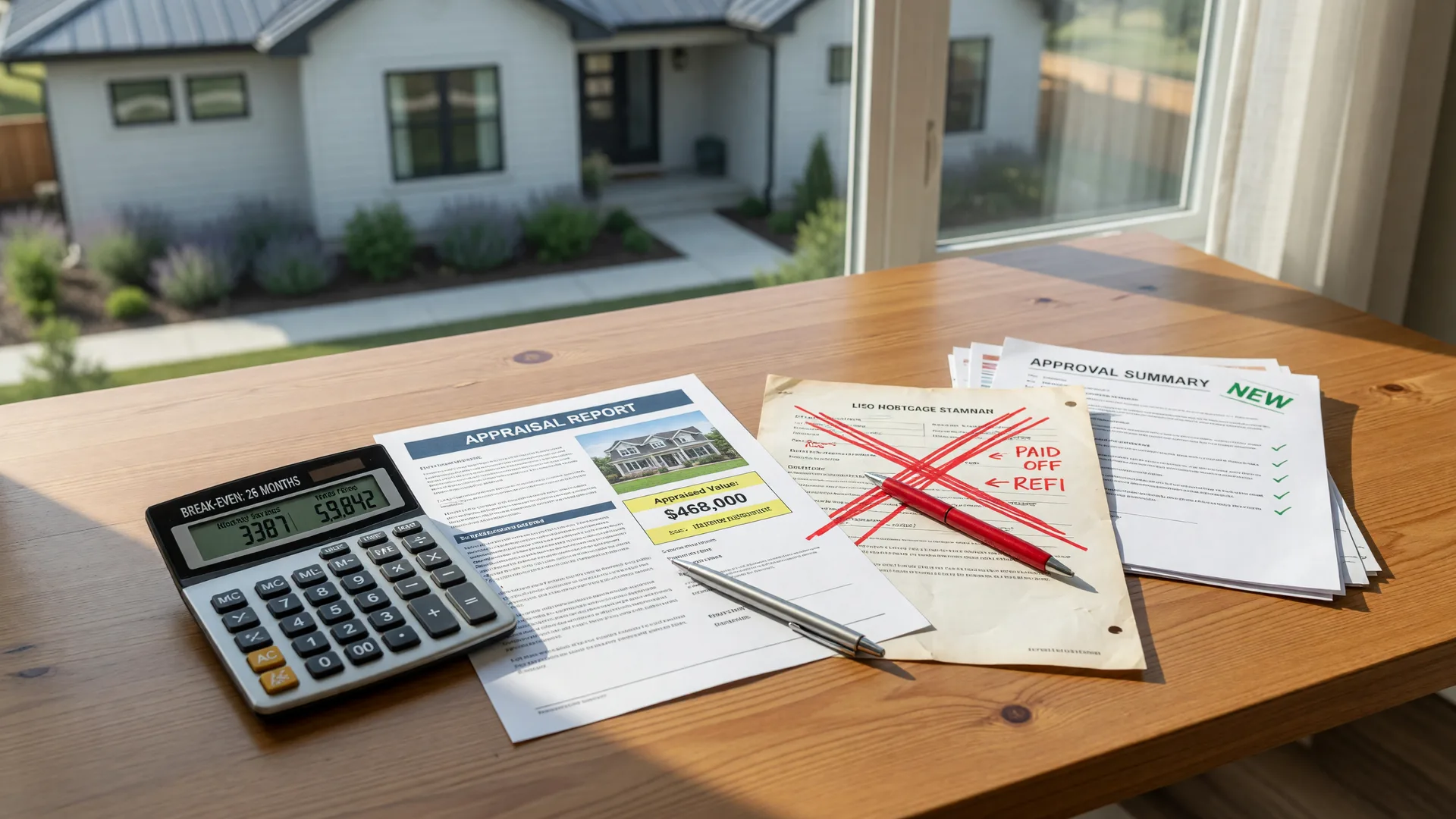
Refinancing your mortgage replaces your current home loan with a new one, ideally at a lower interest rate or with better terms. The key question is whether the savings from the new loan outweigh the closing costs of refinancing. Your break-even point tells you how long it will take for the savings to cover the costs.
Refinancing can be a powerful financial tool, but it is not right for everyone. In South Jersey, where homeowners often stay in their homes for 7 to 10 years, refinancing can save tens of thousands of dollars. But if the numbers do not work, you could end up paying more in the long run.
This guide will walk through the different types of refinancing, how to calculate whether it makes sense for you, and the specific factors South Jersey homeowners need to consider.
What Is Refinancing and How Does It Work?
When you refinance, you take out a new mortgage to pay off your existing mortgage. The new loan has its own terms, interest rate, and repayment schedule. You go through the same application, underwriting, and closing process as your original mortgage, including a new appraisal and credit check.
There are several reasons homeowners refinance:
- Lower your interest rate. The most common reason. A lower rate means lower monthly payments and less interest paid over the life of the loan.
- Shorten your loan term. Switching from a 30-year to a 15-year mortgage can save a fortune in interest, even if the rate is similar.
- Switch from an ARM to a fixed rate. If you have an adjustable-rate mortgage and rates are rising, refinancing to a fixed rate provides stability.
- Cash out your equity. If your home has appreciated, you can refinance for more than you owe and take the difference in cash for home improvements, debt consolidation, or other expenses.
- Remove mortgage insurance. If your home has appreciated enough to give you 20% equity, refinancing into a conventional loan can eliminate FHA MIP or conventional PMI.
Rate-and-Term Refinance: Lowering Your Rate or Changing Your Term
A rate-and-term refinance is the most straightforward type. You keep the same loan balance but get a new interest rate, a new loan term, or both. The goal is to reduce your monthly payment, pay off your loan faster, or both.
When does a rate-and-term refi make sense?
- Current mortgage rates are at least 0.75% to 1% lower than your existing rate
- You plan to stay in your home long enough to recover the closing costs (typically 2-3 years)
- Your credit score has improved since you got your original mortgage, qualifying you for a better rate
- You want to switch from a 30-year to a 15-year term to build equity faster
For example, if you have a $300,000 mortgage at 7.0% and can refinance to 5.75%, your monthly payment drops from $1,996 to $1,751, saving you $245 per month. If closing costs are $6,000, your break-even point is about 24 months. If you plan to stay in the home for at least 2 more years, the refinance makes sense.
Cash-Out Refinance: Tapping Your Home Equity
A cash-out refinance allows you to borrow more than you owe on your current mortgage and take the difference in cash. This is a popular option for homeowners who have built significant equity and want to use it for home improvements, debt consolidation, college tuition, or other major expenses.
Key things to know about cash-out refinancing:
- You can typically borrow up to 80% of your home's value (some lenders allow up to 90% for FHA cash-out)
- Your new mortgage will be larger, so your monthly payment may increase even if your rate is lower
- The interest rate on a cash-out refinance is typically slightly higher than a rate-and-term refinance
- Cash-out refinancing is a common strategy for funding home renovations that increase your property's value
In South Jersey, where home values have appreciated significantly in recent years, many homeowners have built substantial equity. A cash-out refinance can be a smart way to access that equity for improvements that increase your home's value, like a kitchen remodel, bathroom addition, or finished basement.
FHA Streamline and VA IRRRL: Simplified Refinancing
If you have an existing FHA or VA loan, you may qualify for a streamlined refinance that requires less documentation and lower closing costs:
FHA Streamline Refinance. Available to homeowners with existing FHA loans. No appraisal required, limited credit check, and lower closing costs. The goal is to lower your rate or switch from an ARM to a fixed rate. You must have a documented financial benefit, such as a lower monthly payment.
VA Interest Rate Reduction Refinance Loan (IRRRL). Also called a VA Streamline Refinance. Available to veterans with existing VA loans. No appraisal required, no income verification, and lower closing costs. The interest rate must be lower than your current rate, and you must have made at least 6 months of on-time payments on your current loan.
Both of these programs are excellent options for eligible borrowers. They make refinancing faster, easier, and cheaper than a traditional refinance.
How to Calculate Your Break-Even Point
The break-even point is the most important number in any refinance decision. It tells you how many months it will take for your monthly savings to cover the closing costs of the new loan.
Here is the formula:
Break-Even (months) = Total Closing Costs / Monthly Savings
Example:
- Current monthly payment: $2,200
- New monthly payment: $1,950
- Monthly savings: $250
- Closing costs: $6,000
- Break-even: $6,000 / $250 = 24 months
If you plan to stay in your home for more than 24 months, the refinance saves you money. If you plan to move before then, you will lose money on the deal.
A general rule of thumb:
- If you can lower your rate by at least 1% and plan to stay for 3+ years, refinancing is usually worth it
- If you can lower your rate by 0.5% to 1%, run the numbers carefully to see if the break-even works
- If you can lower your rate by less than 0.5%, it rarely makes financial sense unless you are switching from an ARM to a fixed rate
Closing Costs to Expect When Refinancing
Refinancing closing costs typically range from 2% to 5% of the loan amount. On a $300,000 loan, that is $6,000 to $15,000. However, many lenders offer "no-cost" refinancing options where the closing costs are rolled into the loan or offset by a slightly higher interest rate.
Common closing costs include:
- Application fee: $0 to $500
- Origination fee: 0% to 1% of the loan amount
- Appraisal fee: $400 to $700
- Credit report fee: $30 to $50
- Title search and insurance: $500 to $1,500
- Recording fees: $100 to $200
- Prepaid interest and escrow: varies
When comparing refinance offers, look at the APR (which includes fees) rather than just the interest rate. A loan with a slightly higher rate but lower fees may be a better deal, especially if you plan to move in a few years.
When Refinancing Does NOT Make Sense
Refinancing is not always the right move. Here are situations where it probably does not make sense:
- You plan to move within 2-3 years. The closing costs will not have time to pay off.
- You have a low balance on your mortgage. The fixed closing costs make refinancing a small loan uneconomical.
- You have a low credit score. You may not qualify for a rate low enough to justify the costs.
- You are extending your loan term significantly. Refinancing from a 30-year loan with 20 years left to a new 30-year loan means you will be paying interest for 10 more years.
- You are using a cash-out refinance for non-essential spending. Using home equity for vacations, cars, or other depreciating assets is risky.
In South Jersey, many homeowners who bought in the last 2-3 years at higher rates are considering refinancing as rates fluctuate. The key is to run the numbers with your specific loan amount, current rate, and planned time in the home.
South Jersey-Specific Refinance Considerations
South Jersey homeowners face some unique factors when considering a refinance:
Property taxes. New Jersey's high property taxes mean that a significant portion of your monthly payment goes to taxes, not principal and interest. When you refinance, your property taxes do not change, so the savings are only on the principal and interest portion of your payment.
Home values. Many Burlington County communities have seen strong appreciation in recent years. If your home is worth more than you bought it for, your loan-to-value ratio has improved, which may qualify you for better rates and help you drop mortgage insurance.
Local lenders. Working with a local lender who understands the South Jersey market can make the refinance process smoother. They will know the local appraisal trends, understand the property tax system, and can close faster than a national online lender in many cases.
Frequently Asked Questions
How much does refinancing cost in closing costs?
Refinancing closing costs typically range from 2% to 5% of the loan amount. On a $300,000 loan, that is $6,000 to $15,000. Many lenders offer no-cost refinancing options where closing costs are rolled into the loan or offset by a slightly higher rate.
How long does a refinance take?
A typical refinance takes 30 to 45 days from application to closing. FHA Streamline and VA IRRRL refinances can be faster, sometimes closing in 2 to 3 weeks. The timeline depends on the lender's workload, the appraisal turnaround, and how quickly you provide documentation.
Can I refinance if I have no equity in my home?
It depends on the loan type. If you have an FHA loan, you may qualify for an FHA Streamline Refinance without an appraisal, so equity is less of a factor. For conventional loans, you typically need at least 5% equity. VA IRRRL refinances also do not require an appraisal.
Should I refinance to a 15-year mortgage?
Refinancing to a 15-year term can save you a significant amount of interest and help you build equity faster. However, the monthly payment will be higher because you are paying off the loan in half the time. It is a good option if you have stable income, can afford the higher payment, and want to own your home free and clear sooner.
What is the difference between a cash-out refinance and a home equity loan?
A cash-out refinance replaces your existing mortgage with a new, larger mortgage. A home equity loan (or HELOC) is a second mortgage that stays in place behind your existing first mortgage. Cash-out refinancing typically offers lower rates because it is a first mortgage, but it resets your loan term. Home equity loans keep your existing first mortgage in place but have a second monthly payment.
Does refinancing hurt my credit score?
The hard credit inquiry from refinancing may lower your score by 5 to 10 points temporarily. The new loan will also show as a new account, which can slightly lower your average account age. However, the impact is typically minor and short-lived, and your score usually recovers within a few months.
Not Sure If Refinancing Is Right for You?
Refinancing can save you money, but it is not a decision to make lightly. The numbers need to work for your specific situation. I work with trusted local lenders who can run your numbers, explain the costs, and help you decide whether refinancing makes sense.
Reach out anytime. I am happy to answer your questions and connect you with the right people.

Bob Millaway
Epique Realty Agent · AI Certified Agent · 728+ homes sold across Burlington County and South Jersey. Licensed NJ Salesperson #791082.