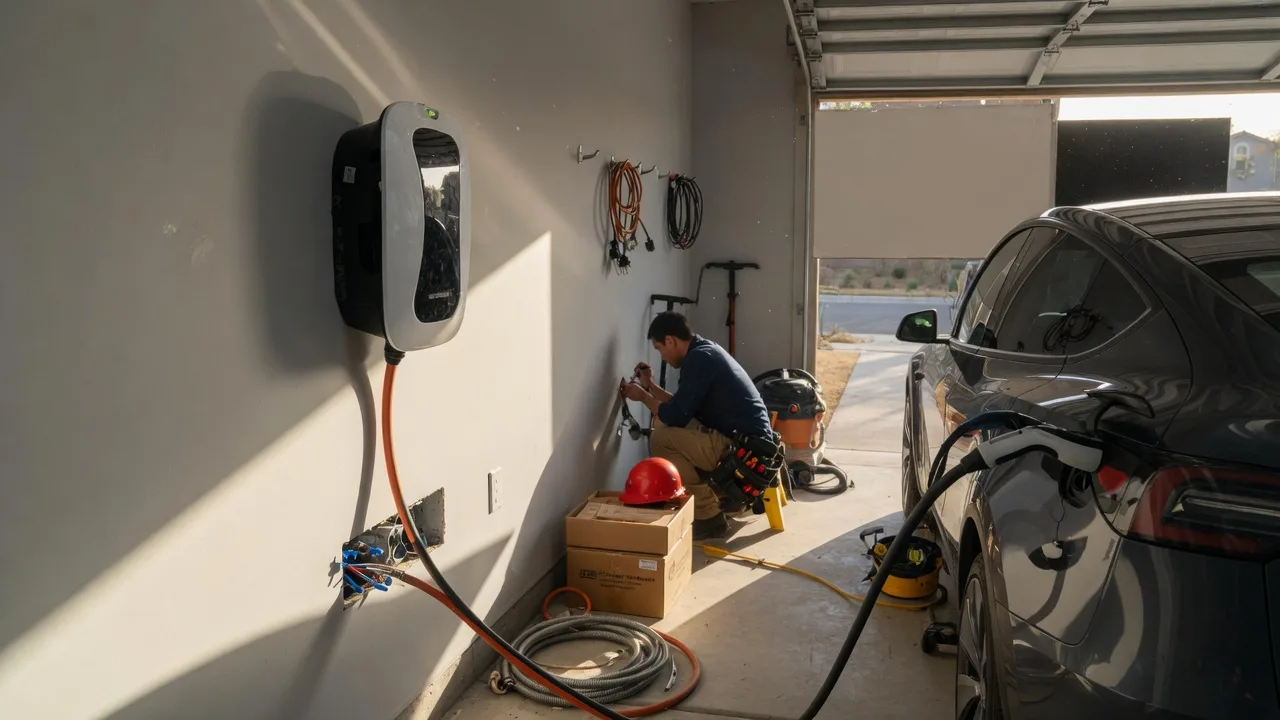
If you own an electric vehicle or are considering buying one, installing a home charger is one of the best investments you can make. Charging at home is more convenient, faster, and significantly cheaper than relying on public charging stations. For South Jersey homeowners, the combination of New Jersey's EV incentives, federal tax credits, and falling charger prices makes this an excellent time to install a home EV charger.
This guide covers everything you need to know about installing an EV charger at your South Jersey home. I will explain the differences between Level 1 and Level 2 charging, what the installation process involves, how much it costs, what electrical requirements your home needs, and what NJ incentives are available to offset the expense.
What Is the Difference Between Level 1 and Level 2 Charging?
Understanding the two levels of home EV charging is the first step in deciding what you need.
Level 1 Charging
Level 1 charging uses a standard 120-volt household outlet, the same type you use to charge your phone or power a lamp. Every EV comes with a Level 1 charging cable that plugs into a standard three-prong outlet.
The pros: No installation cost. You can plug into any standard outlet in your garage or driveway. For plug-in hybrid vehicles with smaller batteries, Level 1 charging may be sufficient if you do not drive many miles per day.
The cons: Level 1 charging is slow. It adds about 3 to 5 miles of range per hour of charging. A full charge for a typical EV with a 60 kWh battery takes 40 to 50 hours. If you drive more than 30 to 40 miles per day, Level 1 charging will not keep up.
Level 2 Charging
Level 2 charging uses a 240-volt circuit, similar to what your electric clothes dryer or oven uses. A dedicated Level 2 charger is mounted on your garage wall or on a pedestal in your driveway.
The pros: Level 2 charging adds 25 to 35 miles of range per hour, meaning a full charge takes 4 to 8 hours. You can easily charge overnight and wake up to a full battery every morning. Level 2 is the standard recommendation for EV owners.
The cons: Requires professional installation by a licensed electrician. The equipment and installation cost $500 to $2,500 depending on your home's electrical setup.
Bottom line: For most South Jersey EV owners, Level 2 charging is the right choice. The convenience of overnight charging makes it worth the investment, and the cost is often offset by NJ incentives and federal tax credits.
How Much Does It Cost to Install an EV Charger at Home?
The total cost of installing a Level 2 EV charger in South Jersey depends on several factors:
- Charger equipment: $400 to $1,200 depending on brand, features, and amperage. Popular brands include ChargePoint, JuiceBox, Grizzl-E, Tesla Wall Connector, and Ford Connected Charge Station.
- Electrical panel capacity: If your panel has available space for a new 240-volt breaker and sufficient capacity, installation is straightforward. This typically costs $300 to $800 for the electrician's labor and materials.
- Panel upgrade: If your panel is full or does not have enough capacity, you may need a panel upgrade or sub-panel. This can add $1,500 to $3,000 to the total cost.
- Distance from panel to charger: The farther the charger is from your electrical panel, the more wiring and conduit are needed. Running conduit 50 feet or more can add $200 to $500 to the installation cost.
- Permit and inspection: Most municipalities in Burlington County require a permit for EV charger installation. Permit fees range from $50 to $200.
Typical total cost:
- Simple installation (panel near garage, available capacity): $800 to $1,500
- Moderate installation (longer wire run, some panel work): $1,500 to $2,500
- Complex installation (panel upgrade or sub-panel needed): $2,500 to $5,000
What Electrical Requirements Does Your Home Need?
Before installing a Level 2 EV charger, a licensed electrician should evaluate your home's electrical system. Here is what they will check:
- Electrical panel capacity: Most homes have a 100-amp, 150-amp, or 200-amp main service. A Level 2 charger requires a 40-amp to 60-amp dedicated circuit. Your electrician will calculate whether your panel has enough capacity to handle the additional load.
- Available breaker slots: The charger needs a double-pole breaker in your panel. If your panel is full, you may need a sub-panel or tandem breakers to make room.
- Wiring gauge: Level 2 chargers require 6-gauge or 8-gauge copper wiring, depending on the amperage. The wire must be rated for the circuit size and distance.
- Conduit: In most areas, the wiring from your panel to the charger must be enclosed in conduit for protection, especially if it runs through a garage or unfinished space.
- GFCI protection: Many local codes require GFCI protection for EV charger circuits, particularly in garage locations.
Most newer homes (built after 2000) have 200-amp service with sufficient capacity for a Level 2 charger. Older homes, particularly those with 100-amp service, may need a service upgrade.
What NJ EV Incentives Are Available for Home Charging?
New Jersey and the federal government offer several incentives that can significantly reduce the cost of installing a home EV charger:
- NJ Charge Up Program: New Jersey's Charge Up program provides rebates for the purchase and installation of qualified Level 2 EV chargers. For single-family homes, the rebate is typically $250 to $500 per charger. The program has specific eligibility requirements, so check the NJ Board of Public Utilities website for current details.
- Federal Alternative Fuel Vehicle Refueling Property Credit: This federal tax credit covers 30% of the cost of EV charger equipment and installation, up to $1,000 for residential installations. The credit is available through 2032 for chargers installed at your primary residence.
- NJ EV sales tax exemption: New Jersey exempts the sale of EV charging equipment from the state sales tax, saving you 6.625% on the equipment purchase.
- Utility rebates: Some New Jersey utilities offer additional rebates for EV charger installation. PSE&G, Atlantic City Electric, and Jersey Central Power & Light have all offered EV charger rebates at various times. Check with your utility provider for current programs.
Total potential savings: Between the NJ Charge Up rebate, federal tax credit, and utility rebates, South Jersey homeowners can save $750 to $1,500 on a typical Level 2 charger installation.
What Should You Know Before Buying an EV?
If you are considering buying an electric vehicle, here are the key things to know before you make the purchase:
- Check your home's electrical panel first: Before buying an EV, have an electrician evaluate your panel. If you need a service upgrade, factor that into your budget.
- Consider your daily driving needs: Most South Jersey residents drive 30 to 50 miles per day for commuting and errands. A Level 2 charger can easily replenish that in 2 hours of overnight charging. Even a basic Level 1 charger can handle shorter commutes.
- Think about future-proofing: If you plan to own two EVs in the future, consider installing a charger that can handle higher amperage or installing conduit that can support a second charger later.
- Research NJ EV purchase incentives: New Jersey offers up to $4,000 or more in rebates for the purchase or lease of a new EV through the NJ Charge Up program. Some models also qualify for federal tax credits of up to $7,500.
- Plan for cold weather: EV range decreases by 20% to 30% in cold weather, so South Jersey winters will affect your driving range. Factor this into your range expectations.
- Consider public charging for road trips: While home charging handles 90% of your daily needs, you will still want access to fast-charging stations for longer trips. South Jersey has a growing network of DC fast chargers at rest stops, Wawa locations, and shopping centers.
How Do You Choose the Right EV Charger for Your Home?
Here are the key factors to consider when choosing a Level 2 charger:
- Connector type: Most EVs use the J1772 connector for Level 2 charging. Tesla vehicles use a proprietary connector, but Tesla includes a J1772 adapter and also sells a Tesla Wall Connector that can be hardwired. If you have a Tesla, consider the Tesla Wall Connector or a universal charger with a Tesla-compatible plug.
- Amperage: Most Level 2 chargers offer 30 to 50 amps. A 40-amp charger on a 50-amp circuit provides a good balance of charging speed and installation cost. Higher amperage charges faster but requires heavier wiring and may need a panel upgrade.
- Smart features: Many chargers offer Wi-Fi connectivity, smartphone apps, scheduling, and energy monitoring. These features let you charge during off-peak hours when electricity rates are lower, saving you additional money.
- Hardwired vs. plug-in: Hardwired chargers are permanently connected to your electrical system and are generally more reliable. Plug-in chargers connect to a NEMA 14-50 outlet (like a dryer outlet) and can be easily removed or moved. Hardwired is recommended for permanent installations.
- Weather rating: If your charger will be installed outdoors (in a driveway, for example), make sure it has a suitable weather rating (NEMA 3R or higher).
Popular charger brands include ChargePoint Home Flex, JuiceBox 40, Grizzl-E Classic, Tesla Wall Connector, and Emporia EV Charger. All are reliable options with good warranty coverage.
Does an EV Charger Increase Home Value?
Yes. A home with an installed EV charger is increasingly attractive to buyers. As EV adoption grows, having a home charger is becoming a desirable feature that can differentiate your home in the market.
A study by the National Renewable Energy Laboratory found that homes with EV charging infrastructure sell for a premium and spend less time on the market. For South Jersey buyers who own or plan to own an EV, a home with a pre-installed charger saves them the hassle and cost of installation, making your home more appealing.
Even if you do not currently own an EV, installing a charger now can be a smart investment. The cost is relatively low compared to other home improvements, and as EV adoption accelerates, having a charger will become an increasingly valuable selling point.
For more on how home features affect value, see our guide on home improvements that actually increase your home value.
Frequently Asked Questions
Can I install an EV charger myself?
How long does it take to charge an EV at home?
What NJ incentives are available for home EV charging?
Do I need a permit to install an EV charger in New Jersey?
Can I install an EV charger if I have a 100-amp panel?
Ready to Install Your Home EV Charger?
Installing a home EV charger is a smart investment that makes owning an electric vehicle more convenient, affordable, and practical. For South Jersey homeowners, the combination of NJ incentives, federal tax credits, and falling equipment costs makes this an ideal time to make the switch.
Whether you are buying a home and want to know if it is EV-ready, or you are planning to install a charger in your current home, I can help you understand the local market and connect you with trusted electricians who specialize in EV charger installation.
Contact Bob or schedule a call to discuss your EV and home goals.

Bob Millaway
Epique Realty Agent · AI Certified Agent™ · 728+ homes sold. I help South Jersey homeowners navigate everything from home energy upgrades to finding the perfect property for their lifestyle.
Contact Bob