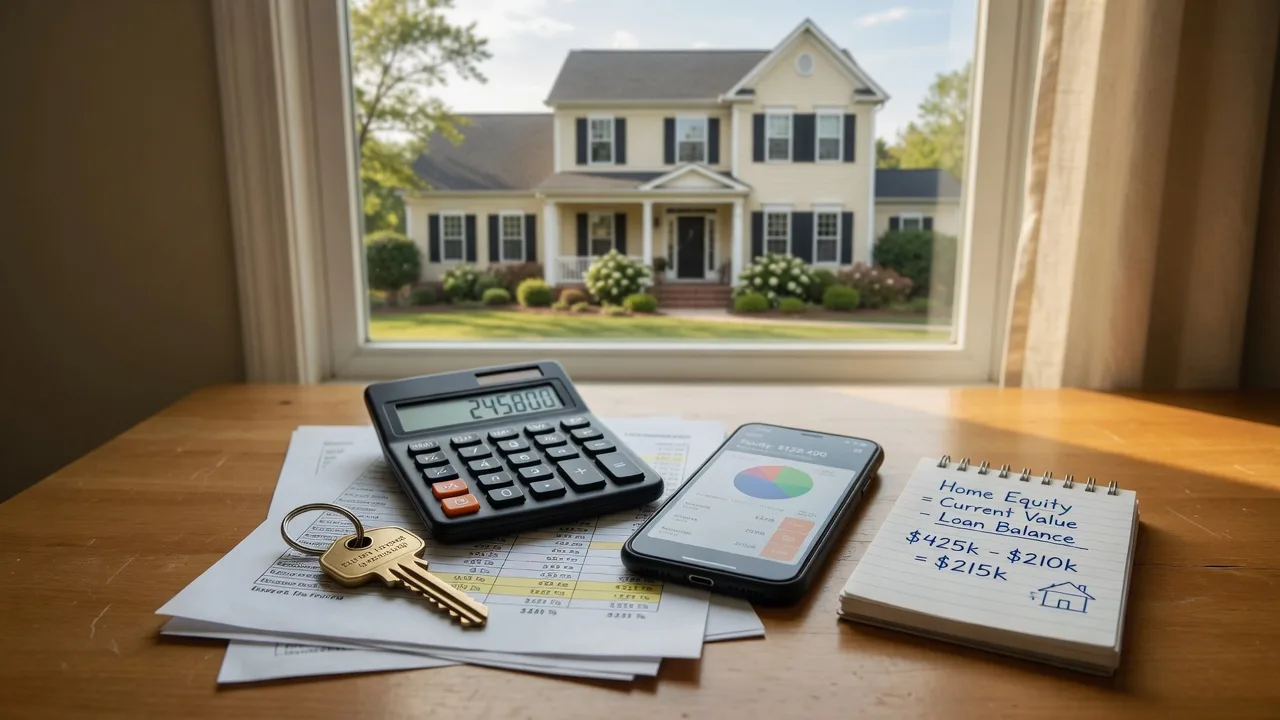
Knowing how to calculate your home's equity is one of the most useful financial skills a homeowner can have. It tells you how much of your home you truly own, what you can borrow against, and how much cash you could walk away with if you sell. The formula is simple, but the implications are powerful.
If you own a home in South Jersey, your equity is likely one of your largest financial assets. According to the ICE Mortgage Monitor, the average U.S. homeowner had roughly $313,000 in home equity as of early 2025, and total homeowner equity reached a record $17.6 trillion. In New Jersey, home prices rose more than 11% in 2024 alone, meaning many homeowners have built significant equity whether they realize it or not.
In this guide, I will walk you through exactly how to calculate your home equity, show you real examples at different price points, explain why it matters, and give you practical steps to build even more equity over time. Whether you are planning to sell, refinance, or just want to understand your financial position better, this is the place to start.
What Is Home Equity?
Home equity is the portion of your property that you actually own, free and clear. It is the difference between what your home is worth on the open market and what you still owe on your mortgage.
Think of it this way. When you buy a home with a mortgage, the bank owns most of it at first. Your down payment is your initial ownership stake. Every mortgage payment you make that reduces your principal increases your ownership. And when your home's value goes up, that increase belongs entirely to you.
Home equity is not the same as cash in the bank. It is wealth tied up in your property. But it is real wealth that you can access through selling, refinancing, or a home equity loan or line of credit (HELOC). For most American families, home equity represents the single largest source of personal wealth outside of retirement accounts.
In New Jersey, where the median home price reached $565,800 in late 2025, the equity stakes are especially high. A homeowner in Burlington County who bought five years ago and has seen appreciation of 8% to 10% per year could easily have $100,000 to $200,000 or more in equity today.
The Simple Formula for Calculating Home Equity
The formula is straightforward:
Home Equity = Current Home Value − Mortgage Balance
That is it. If your home is worth $400,000 and you owe $250,000 on your mortgage, your equity is $150,000.
But there is an important nuance. Your equity percentage also matters. To calculate your equity percentage:
Equity % = (Equity ÷ Home Value) × 100
Using the same example: $150,000 ÷ $400,000 = 0.375. Multiply by 100, and you have 37.5% equity. This percentage matters because lenders typically want you to have at least 20% equity before you can refinance or take out a home equity loan without paying private mortgage insurance (PMI).
Step-by-Step: How to Calculate Your Home Equity
Here is how to do it in three steps.
Step 1: Find Your Home's Current Market Value
Your home's current value is the single most important number in this calculation. It is also the one that changes most often. You cannot use what you paid for the house five or ten years ago. You need today's value.
Here are the best ways to estimate your home's current value:
- Online valuation tools like Zillow's Zestimate or Epique Realty's Estimate give you a quick starting point. In Burlington County, these tools are typically most accurate in newer subdivisions with many similar homes. In established towns with diverse housing stock, they can be off by 10% or more.
- A Comparative Market Analysis (CMA) from a local agent is significantly more accurate. A professional CMA uses recently sold comparable homes in your specific neighborhood, adjusted for differences in size, condition, and features. I provide free CMAs to any South Jersey homeowner.
- A full appraisal is the most accurate method. A licensed appraiser inspects your home and analyzes comparable sales to produce a formal valuation. Appraisals cost $400 to $600 and are typically required when refinancing or taking out a home equity loan.
For a quick equity estimate, start with an online tool. For a number you can base financial decisions on, get a professional CMA. Request a free home valuation from me and I will give you a data-driven estimate of your home's current market value.
Step 2: Find Your Current Mortgage Balance
This is the easy part. Your mortgage servicer (the company you send payments to) provides a monthly statement that shows your current loan balance. You can also log into your online account to see your remaining principal at any time.
A few things to keep in mind:
- Use the principal balance only. Do not include interest, escrow for taxes and insurance, or PMI.
- If you have a second mortgage or home equity line of credit (HELOC), include that balance too. Total equity is calculated against all debt secured by your home.
- Your balance changes every month as you make payments. For the most accurate calculation, use the balance shown on your most recent statement.
Step 3: Subtract the Balance from the Value
Now you have everything you need. Take your estimated home value, subtract your mortgage balance, and the result is your equity.
If the number surprises you, that is normal. Many homeowners in South Jersey have built more equity than they realize, especially if they bought before the recent run-up in home prices.
Example Calculations at Different Price Points
Let me walk through three real-world examples at the price points most common in Burlington County and South Jersey.
Example 1: $300,000 Home (First-Time Buyer or Starter Home)
Home Value: $300,000
Original Purchase Price: $280,000 (5 years ago)
Down Payment: 5% ($14,000)
Original Mortgage: $266,000
Current Mortgage Balance: $238,000 (after 5 years of payments)
Equity: $300,000 − $238,000 = $62,000
Equity Percentage: 20.7%
This buyer started with just 5% down and has built $62,000 in equity through a combination of paying down principal and modest appreciation. They now have enough equity to sell without bringing cash to closing, and they could potentially qualify for a home equity loan if needed.
Example 2: $500,000 Home (Move-Up Buyer or Growing Family)
Home Value: $500,000
Original Purchase Price: $420,000 (7 years ago)
Down Payment: 10% ($42,000)
Original Mortgage: $378,000
Current Mortgage Balance: $310,000 (after 7 years of payments)
Equity: $500,000 − $310,000 = $190,000
Equity Percentage: 38%
This homeowner has built substantial equity through a combination of appreciation (the home's value rose $80,000 over 7 years) and paying down $68,000 in principal. With 38% equity, they have excellent options. They could use the equity as a down payment on a larger home, finance a major renovation, or refinance to a better rate.
Example 3: $700,000 Home (Established Homeowner or Premium Market)
Home Value: $700,000
Original Purchase Price: $550,000 (10 years ago)
Down Payment: 20% ($110,000)
Original Mortgage: $440,000
Current Mortgage Balance: $290,000 (after 10 years of payments)
Equity: $700,000 − $290,000 = $410,000
Equity Percentage: 58.6%
This homeowner started with a strong down payment and has benefited from significant appreciation over a decade. With nearly 60% equity, they have tremendous financial flexibility. They could sell and walk away with over $400,000 in cash, buy a retirement home outright, or use the equity to invest in a second property. This is a common scenario for homeowners in towns like Moorestown, Medford, and Mount Laurel, where values have appreciated steadily.
Why Home Equity Matters
Your home equity is not just a number on a spreadsheet. It is a financial tool that can open doors. Here is why paying attention to your equity matters.
Selling Your Home
When you sell, your equity minus selling costs (agent commissions, closing costs, and any repairs or concessions) determines how much cash you take away. More equity means more money for your next down payment, your retirement fund, or your next chapter. Understanding your equity position before you list helps you set realistic expectations and plan your next move.
Refinancing
Lenders generally require at least 20% equity to refinance without paying PMI. The more equity you have, the better your refinancing options. If interest rates have dropped since you bought, refinancing with strong equity can lower your monthly payment significantly.
Borrowing Against Your Equity
Home equity loans and HELOCs let you borrow against your home's value at relatively low interest rates. Many homeowners use these funds for home improvements, debt consolidation, education expenses, or even starting a business. The key is borrowing responsibly. Your home secures the loan, so missing payments puts your home at risk.
Retirement Planning
For many retirees, home equity is a significant part of their retirement nest egg. Options like downsizing to a smaller home, relocating to a lower-cost area, or using a reverse mortgage can unlock equity for living expenses in retirement. Knowing your equity position early lets you plan with confidence.
How to Build Home Equity Faster
Whether you are just starting out or have been in your home for years, there are strategies to build equity faster.
1. Make a Larger Down Payment
The more you put down upfront, the more equity you start with. A 20% down payment also eliminates PMI, saving you money every month that can instead go toward principal.
2. Pay Down Your Mortgage Faster
Extra principal payments, even small ones, accelerate equity growth. Biweekly payment schedules, rounding up your payment, or applying bonuses and tax refunds to your principal all make a difference. If you add just $100 extra per month to your principal on a $300,000 mortgage, you could shave years off your loan term and save thousands in interest.
3. Make Strategic Home Improvements
Not all renovations increase value dollar for dollar, but the right ones do. Kitchen and bathroom remodels, new flooring, fresh paint, improved curb appeal, and energy-efficient upgrades can boost your home's market value. Focus on improvements that matter to buyers in your neighborhood and price range. Learn more about which improvements add the most value.
4. Let Market Appreciation Work for You
You cannot control the market, but you can benefit from it. In South Jersey, home values have appreciated steadily over the long term. Burlington County's median home price has grown from roughly $270,000 five years ago to around $370,000 to $400,000 today. Simply holding onto your home in a growing market builds equity automatically.
5. Refinance to a Shorter Term
If you can afford higher monthly payments, refinancing from a 30-year mortgage to a 15-year mortgage accelerates equity building dramatically. You pay off the loan in half the time and build equity much faster. This strategy works best when you have stable income and plan to stay in the home for several more years.
South Jersey Home Equity: Local Context and Trends
Understanding the local market is essential for any South Jersey homeowner calculating their equity. Here is what you need to know about Burlington County and the surrounding area.
As of late 2025, the median home price in Burlington County was approximately $370,000 to $401,000, depending on the data source. The median sale price per square foot was around $240, up 6.4% year over year. While the pace of appreciation has moderated compared to the boom years of 2020 to 2022, home values in Burlington County continue to hold steady and grow modestly.
Across New Jersey, home prices rose more than 11% in 2024, far outpacing the national average of 4.6%. The statewide median home price reached $565,800 in late 2025, a 5.9% year-over-year increase. This sustained appreciation has built significant equity for homeowners across the state, especially those who bought before 2020.
Median home prices in key Burlington County towns:
- Moorestown: Median sale price around $618,000 to $799,000, depending on the specific neighborhood and property type. One of the most desirable towns in the county with strong appreciation.
- Medford: Median sale price around $625,000. Known for its historic charm, excellent schools, and larger lots. Equity growth has been steady.
- Mount Laurel: Median home value around $430,000 with a median sale price of $389,000 to $409,000. A popular choice for families and commuters with strong demand.
- Marlton (Evesham): Median prices in the $450,000 to $550,000 range. Highly sought after for its schools and central location.
- Hainesport, Lumberton, Southampton: These towns typically fall in the $350,000 to $500,000 range, offering excellent value and good equity potential.
What does this mean for your equity? If you bought in any of these towns three to five years ago, you have likely seen double-digit appreciation. Even if you bought recently with a smaller down payment, your equity is growing with every payment and every tick upward in the market.
Home Equity Tools and Resources
You do not need to be a math expert to calculate your home equity. Several tools can help.
Online Home Equity Calculators
Many financial websites offer free home equity calculators. You plug in your estimated home value and mortgage balance, and they calculate your equity and equity percentage instantly. NerdWallet, Bankrate, and Zillow all offer reliable calculators. Use them as a starting point, but remember that the accuracy depends entirely on the home value estimate you enter.
Professional Home Valuation
For a number you can trust, nothing beats a professional valuation from a local expert. As an Epique Realty Agent who has helped over 728 families buy and sell homes in Burlington County and South Jersey, I provide detailed, no-obligation valuations that account for your home's specific condition, location, and recent comparable sales. Request your free home valuation and I will give you a clear picture of your home's current market value.
Comparative Market Analysis (CMA)
A CMA is the most practical tool for understanding your home's value in the current market. I prepare CMAs daily for homeowners across Burlington County. The analysis compares your home to similar properties that have recently sold, are currently listed, or failed to sell, giving you a realistic price range backed by real data.
Full Appraisal
When you need a formal, documented value for a refinance, home equity loan, estate planning, or tax appeal, a licensed appraiser provides the definitive answer. Expect to pay $400 to $600 for a full appraisal in South Jersey.
Frequently Asked Questions About Home Equity
How do I calculate my home's equity?
Subtract your mortgage balance from your home's current market value. For example, if your home is worth $400,000 and you owe $250,000, your equity is $150,000. For a more detailed walkthrough, see my full answer to this question.
How much equity do I need to refinance?
Most lenders require at least 20% equity to refinance without paying private mortgage insurance (PMI). Some loan programs allow refinancing with as little as 5% to 10% equity, but you will likely pay higher rates or PMI. The more equity you have, the better your refinancing options.
Can I use my home equity before selling?
Yes. You can access your equity through a home equity loan (a lump sum at a fixed rate) or a home equity line of credit (HELOC, a revolving credit line with a variable rate). Both use your home as collateral. Many South Jersey homeowners use these funds for renovations, debt consolidation, or major purchases. Borrow responsibly and understand the risks.
How quickly can I build home equity?
Equity builds through three channels: paying down your mortgage principal, market appreciation, and home improvements. In a market like South Jersey where values have appreciated 5% to 11% annually, equity can grow quickly. A buyer who put 10% down on a $400,000 home three years ago might have 25% to 35% equity today, depending on their specific town and market conditions.
What is the difference between equity and tappable equity?
Total equity is your home's full value minus your mortgage balance. Tappable equity is the amount you can borrow against while still maintaining at least 20% equity in your home. Lenders typically let you borrow up to 80% of your home's value, minus your existing mortgage balance. The average US homeowner has about $203,000 in tappable equity as of early 2025.
Does my home equity change if home prices drop?
Yes. Since equity depends on your home's current market value, a significant market downturn would reduce your equity. If your home value drops below your mortgage balance, you would have negative equity, also known as being underwater. This is rare in Burlington County's historically stable market, but it is a risk to consider when borrowing against your equity.
Should I use my home equity to pay off debt?
Home equity loans and HELOCs typically offer lower interest rates than credit cards or personal loans, making them an attractive option for debt consolidation. However, your home secures the loan, so you risk foreclosure if you cannot make payments. A home equity loan makes the most sense when you have a clear plan to repay it and are consolidating debt that you will not run up again.
The Final Verdict: What to Do With Your Home Equity
Your home equity is one of your most valuable financial assets. Whether you have $20,000 or $200,000 in equity, knowing that number gives you clarity and options.
Here is what I recommend to South Jersey homeowners:
- If you are planning to sell, your equity minus selling costs determines your net proceeds. Knowing this number early helps you plan your next move with confidence. Check out the Home Value Guide for more on how value translates to cash at closing.
- If you are thinking about refinancing, your equity percentage determines whether you qualify and what terms you can get. The more equity, the better the deal.
- If you are considering a home equity loan or HELOC, understand the terms, the risks, and your repayment plan before you borrow. Your home is on the line.
- If you are planning for retirement, your equity is a key part of your financial picture. Whether you downsize, relocate, or tap your equity, knowing your position early lets you plan wisely.
The most important step is the first one: calculating your equity accurately. You can do it yourself with the formula above, or you can reach out and I will help you with a professional, no-obligation valuation.
Want to know your home's equity? Contact Bob Millaway at 856.426.1522

Bob Millaway
Epique Realty Agent · AI Certified Agent · 728+ homes sold across Burlington County and South Jersey. Licensed NJ Salesperson #791082.