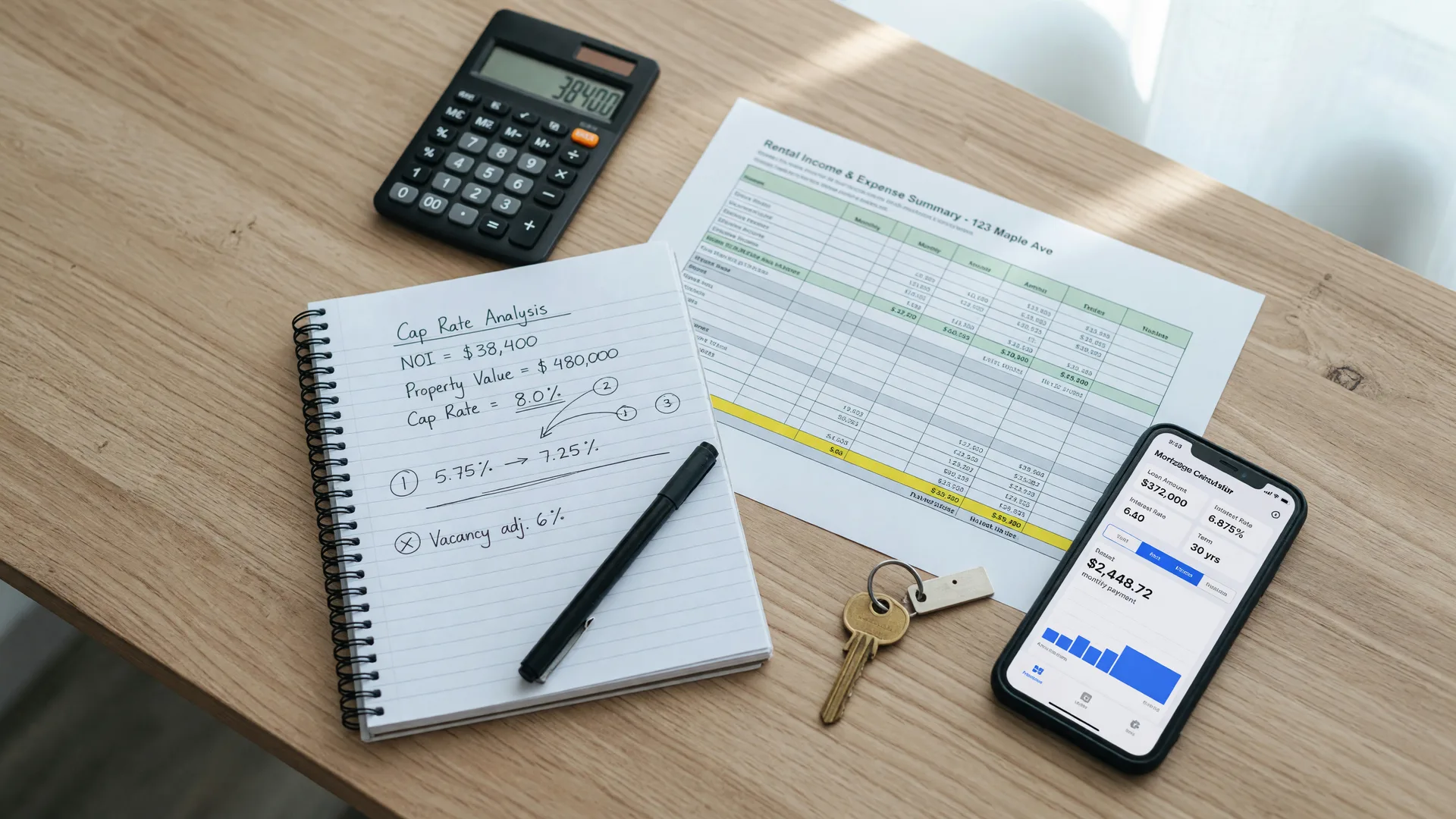
The capitalization rate, or cap rate, is one of the most important metrics for evaluating rental property investments. It tells you the expected rate of return on a property based on its net operating income, without factoring in financing. For South Jersey investors, understanding how to calculate and interpret cap rates is essential for comparing properties across different towns, price points, and property types.
I have helped over 728 families buy and sell homes across South Jersey, and I have worked with many investors who use cap rate as their primary screening tool. This guide walks through the formula, real-world examples using South Jersey property data, and how to use cap rates to make smarter investment decisions.
NOI / Value
Cap Rate Formula
6-8%
Typical South Jersey Cap Rate
$375K
Median Home Price Burlington County
728+
Homes Helped By Bob
What Is a Cap Rate?
The cap rate is the ratio of a property's net operating income (NOI) to its current market value or purchase price. It represents the annual return an investor would expect if they paid cash for the property. Because it excludes financing costs, it allows you to compare properties regardless of how you plan to pay for them.
The formula is simple: Cap Rate = Net Operating Income / Property Value. The result is expressed as a percentage. A property with a 7% cap rate generates net operating income equal to 7% of its purchase price each year.
How Do I Calculate Net Operating Income?
Net operating income is your rental income minus all operating expenses, excluding mortgage payments. Here is how to calculate it for a South Jersey rental property:
Start with gross rental income: Add up the annual rent you expect to collect. For a single-family home in Mount Laurel renting for $2,200 per month, your gross annual income is $26,400.
Subtract vacancy loss: Even in strong markets, you will have vacancy between tenants. Budget 5% to 10%. At 8%, that is $2,112.
Effective gross income: $26,400 minus $2,112 equals $24,288.
Subtract operating expenses: These include property taxes, insurance, maintenance, property management (if applicable), utilities you pay, HOA fees, and repairs. Do not include mortgage payments, as cap rate is a financing-neutral metric.
For a typical South Jersey single-family rental, annual operating expenses might look like this:
- Property taxes: $7,500 (based on 2.5% rate on a $300,000 property)
- Insurance: $1,200
- Maintenance and repairs: $3,000 (1% of property value)
- Property management (8%): $2,112
- Total expenses: $13,812
Net operating income: $24,288 minus $13,812 equals $10,476.
Cap Rate = $10,476 / $300,000 = 3.5%
This is a simplified example. Your actual numbers will vary based on the specific property, location, and condition.
What Is a Good Cap Rate in South Jersey?
Cap rates vary significantly by market, property type, and neighborhood. In South Jersey, cap rates for single-family rental properties typically range from 6% to 8%. Premium towns like Moorestown and Medford often have lower cap rates because higher home prices compress the ratio, while more affordable communities like Willingboro and Pemberton may offer higher cap rates.
Here is what cap rates generally look like across South Jersey:
- Premium suburbs (Moorestown, Medford, Haddonfield): 4% to 6% cap rate. Lower returns but stronger appreciation and higher-quality tenants.
- Mid-range suburbs (Mount Laurel, Marlton, Cherry Hill): 5% to 7% cap rate. Good balance of cash flow and appreciation potential.
- Value markets (Willingboro, Burlington City, Florence, Pemberton): 7% to 9% cap rate. Higher cash flow but potentially more tenant turnover and maintenance.
- Multi-unit properties (2-4 units): 6% to 8% cap rate. More units mean more income diversification but also more management complexity.
A "good" cap rate depends on your investment goals. If you are prioritizing cash flow, you want higher cap rates. If you are prioritizing appreciation and long-term equity growth, you may accept a lower cap rate in a stronger market.
How Do I Use Cap Rate to Compare Investment Properties?
Cap rate is most useful as a comparative tool. When you are looking at two similar properties in the same market, the one with the higher cap rate is generally the better investment from a cash flow perspective. But cap rate should never be the only metric you use.
Here are the limitations of cap rate that every South Jersey investor should understand:
- Cap rate does not account for financing: Two investors with different mortgage terms will have different cash-on-cash returns even if the cap rate is the same.
- Cap rate does not account for appreciation: A property in a high-appreciation area may have a lower cap rate but deliver a better total return over time.
- Cap rate is based on projected income: If your rent estimates are too optimistic or your expense estimates are too low, your cap rate calculation will be misleading.
- Cap rate varies by property type: Multi-unit properties typically have higher cap rates than single-family homes because they are viewed as higher risk.
South Jersey Cap Rate Example: A Real-World Comparison
Let us compare two actual South Jersey investment scenarios to see how cap rate works in practice.
Property A: Single-family home in Mount Laurel priced at $350,000, renting for $2,400 per month. Annual property taxes: $8,750. Annual insurance: $1,300. Maintenance budget: $3,500. Property management: 8% of rent. Vacancy allowance: 8%.
Gross income: $28,800. Vacancy loss: $2,304. Effective gross income: $26,496. Total expenses: $8,750 (taxes) + $1,300 (insurance) + $3,500 (maintenance) + $2,112 (management) = $15,662. NOI: $26,496 minus $15,662 = $10,834. Cap Rate: 3.1%
Property B: Single-family home in Willingboro priced at $220,000, renting for $1,800 per month. Annual property taxes: $5,500. Annual insurance: $1,100. Maintenance budget: $2,200. Property management: 8%. Vacancy allowance: 8%.
Gross income: $21,600. Vacancy loss: $1,728. Effective gross income: $19,872. Total expenses: $5,500 (taxes) + $1,100 (insurance) + $2,200 (maintenance) + $1,584 (management) = $10,384. NOI: $19,872 minus $10,384 = $9,488. Cap Rate: 4.3%
In this example, Property B in Willingboro offers a higher cap rate, meaning it generates more cash flow relative to its purchase price. But Property A in Mount Laurel may offer stronger appreciation potential and a higher-quality tenant pool. Your choice depends on your investment strategy.
What Other Metrics Should I Use Alongside Cap Rate?
Cap rate is a starting point, not a final answer. Smart investors use multiple metrics to evaluate a property:
- Cash-on-cash return: Your annual pre-tax cash flow divided by your total cash invested (down payment, closing costs, repairs). This is the most practical metric for most investors because it accounts for your actual financing.
- Total return: Cash flow plus appreciation. A property with a 5% cap rate and 4% annual appreciation delivers a 9% total return.
- Gross rent multiplier (GRM): Property price divided by annual gross rent. A quick screening tool, but it does not account for expenses. Lower GRM is generally better.
- Debt service coverage ratio (DSCR): NOI divided by annual debt payments. Lenders want to see at least 1.25, meaning your NOI covers your mortgage payments by 25% or more.
How Do Property Taxes Affect Cap Rate in New Jersey?
Property taxes are the single largest operating expense for most New Jersey rental properties. At an average effective rate of about 2.5% in Burlington County, property taxes can consume 30% to 40% of your gross rental income. This directly impacts your NOI and, by extension, your cap rate.
When comparing properties across different towns, always factor in the actual property tax bill, not just the purchase price. A $300,000 home in a town with a 2.2% tax rate has annual taxes of $6,600, while the same-priced home in a town with a 3.0% rate costs $9,000 per year. That $2,400 difference significantly affects your cap rate.
Frequently Asked Questions About Cap Rates in South Jersey
What is the average cap rate for rental properties in South Jersey?
For single-family rentals, cap rates typically range from 6% to 8%. Premium towns like Moorestown and Medford may be lower, while value markets like Willingboro and Pemberton tend to be higher. Multi-unit properties generally fall in the 6% to 8% range.
Is a higher cap rate always better?
Not necessarily. A higher cap rate often indicates higher risk, more tenant turnover, or a less desirable location. A lower cap rate in a premium town may deliver better total returns when you factor in appreciation and tenant quality.
Does cap rate include mortgage payments?
No. Cap rate is calculated using net operating income, which excludes mortgage payments. This makes it a financing-neutral metric that allows you to compare properties regardless of how you plan to pay for them.
How do I calculate cap rate on a property I already own?
Use the same formula: divide your actual net operating income by the current market value of the property. This tells you what your current return would be if you sold the property at today's market price.
What is the difference between cap rate and cash-on-cash return?
Cap rate measures return on the full property value regardless of financing. Cash-on-cash return measures return on the actual cash you invested, including your down payment and closing costs. Cash-on-cash is more relevant for most investors because it accounts for leverage.
How do I know if a seller's cap rate claim is accurate?
Always verify the underlying numbers. Ask for actual rent rolls, tax bills, insurance quotes, and maintenance records. Sellers often use optimistic rent projections and underestimate expenses, which inflates the cap rate. Run your own calculation based on verified data.
Need Help Analyzing a South Jersey Investment Property?
Running cap rate calculations is just the first step. I help investors evaluate properties across Burlington County and South Jersey, providing market data, neighborhood insights, and honest guidance on whether a property pencil outs. With 20 years of experience and 728+ homes sold, I know what makes a good investment in this market.
Let us talk about your investment goals. No pressure, no obligation, just real data and honest advice.

Bob Millaway
Epique Realty Agent and AI Certified Agent with 20+ years of experience and 728+ homes sold across Burlington County and South Jersey. Bob combines local expertise, honest guidance, and cutting-edge technology to help investors make confident real estate decisions.
About Bob